Financial-monetary integration and sustainable development in Iraq:analysis of the asymmetric impact of green financing thresholds using thetvar-Copula model
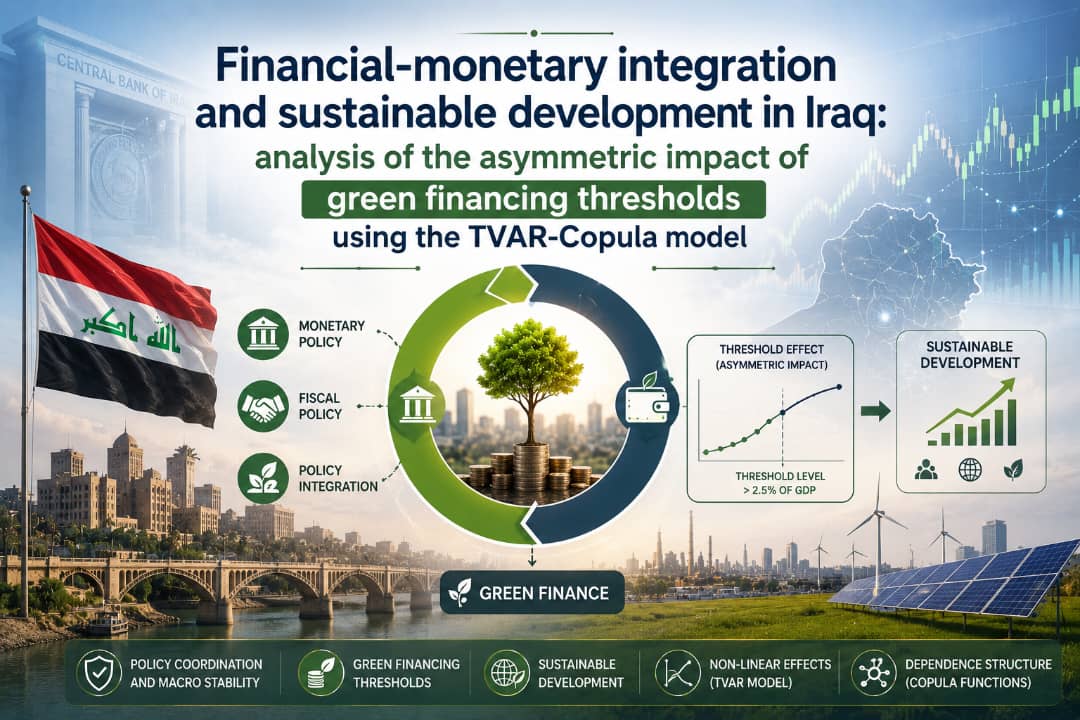
this research seeks to analyze the relationship between the integration of monetary and financial policies and green finance in Iraq, focusing on the adjusted role of green finance thresholds, as economic policies in Iraq suffer from structural challenges represented by poor institutional coordination between the central bank and the Ministry of Finance, and the dominance of oil revenues on the public budget, the research used the tzavalis (2023). The research was based on annual data for the period 2004-2023 from official sources, and the research came to the conclusion that there is a critical threshold for green financing exceeding 2.5% of GDP, as the impact of policy integration turns from limited to effective in supporting sustainable development, and the results show that ignoring the threshold variable leads to biased estimates, which confirms the importance of the proposed methodology

This work is licensed under a Creative Commons Attribution-NonCommercial 4.0 International License.
- 1. Akawee, O. M., & Atiyah, H. R. (2026). Coordination between Monetary Policy and Fiscal Policy in Achieving Economic Stability in Iraq during the Period (2005–2024). Iraqi Journal for Administrative Sciences, 22(87), 631–649.
- 2. Al-Hafi, A. T. M. (2025). The Employment of Monetary and Fiscal Policy Instruments in Achieving Economic Goals in Iraq – A Model. Master's Thesis, University of Mosul.
- 3. Central Bank of Iraq (CBI). (2024). Environmental, Social, and Governance (ESG) Guidelines for the Banking Sector. Baghdad: CBI.
- 4. Christopoulos, D., McAdam, P., & Tzavalis, E. (2023). Threshold Endogeneity in Threshold VARs: An Application to Monetary State Dependence. Federal Reserve Bank of Kansas City, Research Working Paper No. 23-09.
- 5. Ghadeer, Y. H., & Khudhair, L. B. (2022). The Role of Monetary Policy Tools on Stability of Iraqi Economy: A Macroeconomic Analysis (2004-2018). NeuroQuantology Journal, 19(1), 2341-2356.
- 6. Ghazi, K. T., Sabri, H. A., & Khalid, B. M. (2025). The Role of Monetary Sterilization Mechanisms in Achieving Monetary Stability in Iraq. Shirkah: Journal of Economics and Business.
- 7. Hansen, B. E. (1999). Threshold Effects in Non-Dynamic Panels: Estimation, Testing, and Inference. Journal of Econometrics, 93(2), 345-368.
- 8. International Labour Organization (ILO). (2025). Strengthening the Financial Sector's Capacity to Support Green Growth and Decent Jobs in Iraq. United Nations in Iraq.
- 9. Joe, H. (2014). Dependence Modeling with Copulas. Boca Raton: CRC Press.
- 10. Mishkin, F. S. (2019). The Economics of Money, Banking, and Financial Markets (12th ed.). New York: Pearson.
- 11. Najaf, T. S. (2024). The Impact of Fiscal and Monetary Policy on Economic Growth in Iraq. SALAM: Islamic Economics Journal, 5(1), 10-24.
- 12. Rosen, H. S., & Gayer, T. (2014). Public Finance (10th ed.). New York: McGraw-Hill.
- 13. Rudaw Research Center. (2026). Iraq's Economy, 2015–2025: Public Expenditure Analysis. Erbil: Rudaw Research Center.
- 14. Thanoon, B. S., & Battall, A. H. (2026). The Effectiveness of Monetary Policy in Supporting Renewable Energy and Environmental Sustainability: Iraq's Experience After 2004. IOP Conference Series: Earth and Environmental Science, 1596, 012047.
- 15. Tsay, R. S. (1998). Testing and Modeling Multivariate Threshold Models. Journal of the American Statistical Association, 93(443), 1188-1202.
- 16. World Bank. (2025). Climate Investment Plan for Iraq. Washington, DC: World Bank Group.
- 17. Zayer, S. (2019). Monetary and Fiscal Policy Coordination in Iraq. (As cited in Najaf, 202