
Using Explainable Artificial IntelligenceTo Extract and Interpret Monetary SignalsFrom Digital Financial Behavior:Evidence from Jordan
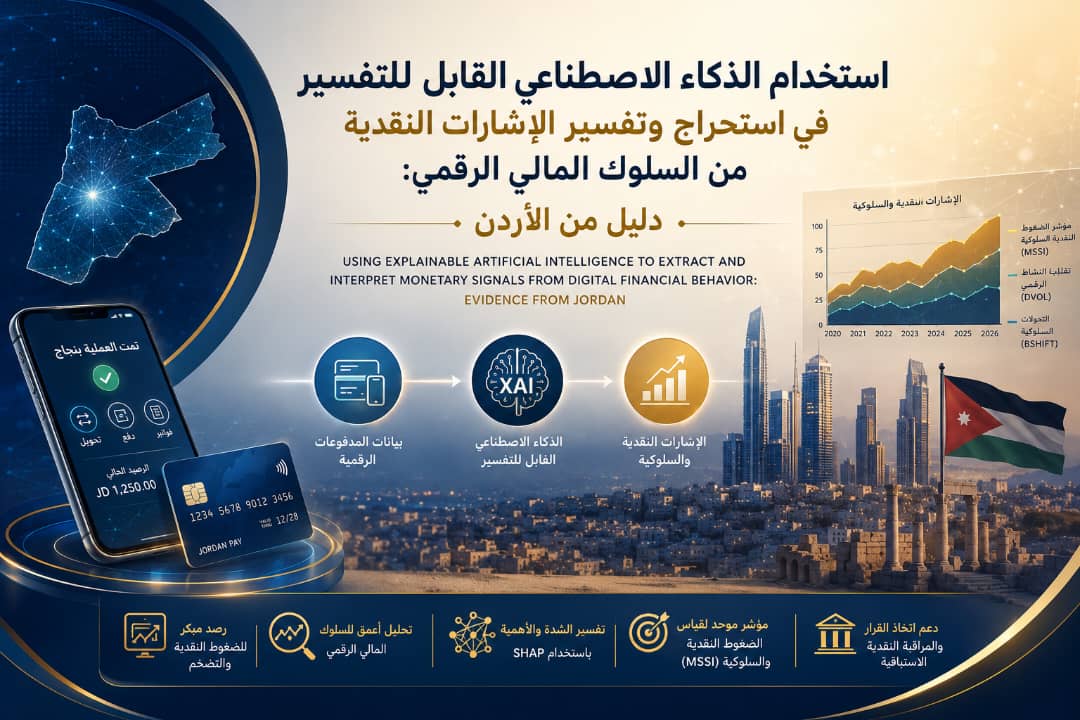
This study examines the ability of digital payment data to uncover latent monetary and behavioral signals embedded in digital financial behavior and associated with inflation dynamics and short-term economic pressures in Jordan. The study addresses the limited capacity of traditional low-frequency monetary indicators to capture rapidly evolving behavioral and financial transformations in digital economies.
A quantitative analytical approach was adopted, combining conventional econometric methods with Explainable Artificial Intelligence techniques. The analysis uses monthly data covering August 2020 to February 2026 and develops a Digital Payment Index (DPI), derived behavioral indicators, and a Monetary Stress Signal Index (MSSI). The empirical analysis employs Vector Autoregression, impulse response analysis, forecast error variance decomposition, Granger causality tests, XGBoost, and SHAP to examine dynamic and nonlinear relationships and identify the relative importance of digital behavioral signals.
The findings indicate that digital payment data contain economically interpretable monetary and behavioral signals associated with inflation dynamics and short-term monetary conditions. Although the direct linear relationship between aggregate digital activity and inflation is limited, the analysis reveals latent nonlinear monetary and behavioral patterns within digital payment activity. Digital activity volatility and behavioral shifts demonstrate greater explanatory relevance than the aggregate level of digital activity, while the MSSI provides a unified measure of evolving monetary and behavioral pressures over time.
The study contributes to the development of a Behavioral Monetary Signals framework that integrates monetary economics, digital financial behavior, and Explainable Artificial Intelligence.

This work is licensed under a Creative Commons Attribution-NonCommercial 4.0 International License.
- Aliaj, Tesi, Milos Ciganovic, & Massimiliano Tancioni. 2023. Nowcasting inflation with Lasso-regularized vector autoregressions and mixed frequency data. Journal of Forecasting 42(3): 464-80. https://doi.org/10.1002/for.2944
- Aparicio, Diego & Manuel I. Bertolotto. (2020). Forecasting inflation with online prices. International Journal of Forecasting 36(2): 232-47. https://doi.org/10.1016/j.ijforecast.2019.04.018
- Aprigliano, V., Ardizzi, G., & Monteforte, L. (2019). Using Payment System Data to Forecast Economic Activity. International Journal of Central Banking. 15 (4): 55-80
- Badrawani, M. (2025). An Interpretable Machine Learning Approach in Predicting Inflation Using Payments System Data: A Case Study of Indonesia. arXiv:2506.10369 [econ.GN]. arxiv.org. https://doi.org/10.48550/arXiv.2506.10369
- Bank for International Settlements (BIS). (2026). Project Spectrum: Using generative AI to enhance inflation nowcasting. BIS Innovation Hub. https://www.bis.org/publ/othp109.pdf
- Beck, Günter W., Kai Carstensen, Jan-Oliver, M, Richard, S, and Wieland, E. (2023). Nowcasting consumer price inflation using high-frequency scanner data: Evidence from Germany. Deutsche Bundesbank Discussion Paper No. 34/2023.
- Buckmann, M., Joseph, A. (2023). An interpretable machine learning workflow with an application to economic forecasting. International Journal of Central Banking, 19(4), 449–500.
- Cavallo, A. (2013). Online and official price indexes: Measuring Argentina’s inflation. Journal of Monetary Economics, 60(2), 152–165. https://doi.org/10.1016/j.jmoneco.2012.10.002
- Cavallo, A, & Rigobon, R.( 2016). The Billion Prices Project: Using Online Prices for Measurement and Research. Journal of Economic Perspectives. 30(2): 151-78. https://doi.org/10.1257/jep.30.2.151
- Chapman, J., & Desai, A. (2022). Macroeconomic Predictions Using Payments Data and Machine Learning. Bank of Canada Staff Working Paper 2022-10. DOI: https://doi.org/10.34989/swp-2022-10
- Chen, T., & Guestrin, C. (2016). XGBoost: A scalable tree boosting system. In Proceedings of the 22nd ACM SIGKDD International Conference on Knowledge Discovery and Data Mining: 785–794.
- Cimadomo, Jacopo, Domenico Giannone, Michele Lenza, Francesca Monti, and Andrej S. (2022). Nowcasting with large Bayesian vector autoregressions. Journal of Econometrics. 231(2): 500-19. https://doi.org/10.1016/j.jeconom.2021.04.012
- Dedola, L, Henkel, C Höynk, C Osbat & Santoro (2025). What does new micro price evidence tell us about inflation dynamics and monetary policy transmission?. ECB Economic Bulletin, Issue 3.
- Friedman, M. (1961). The lag in effect of monetary policy. Journal of Political Economy, 69(5), 447–466.
- Galbraith, J. W., & Tkacz, G. (2018). Nowcasting with payments system data. International Journal of Forecasting, 34(2), 366–376. https://doi.org/10.1016/j.ijforecast.2016.10.002
- Giannone, D, Lucrezia R, & David S. (2008). Nowcasting: The Real-Time Informational Content of Macroeconomic Data. Journal of Monetary Economics. 55(4): 665–76. https://doi.org/10.1016/j.jmoneco.2008.05.010
- Harchaoui, T., & Janssen, R. (2018). How can big data enhance the timeliness of official statistics?: The case of the U.S. consumer price index. International Journal of Forecasting. 34 (2): 225-234. https://doi.org/10.1016/j.ijforecast.2017.12.002
- Knotek, E & Zaman, S. (2017). Nowcasting U.S. Headline and Core Inflation. Journal of Money, Credit and Banking. 49(5): 931–68. https://doi.org/10.1111/jmcb.12401
- Knotek, E & Zaman, S. (2024). Nowcasting Inflation. Working Paper No. 24-06. Federal Reserve Bank of Cleveland. https://doi.org/10.26509/frbc-wp-202406.
- Lundberg, S. M., & Lee, S.-I. (2017). A unified approach to interpreting model predictions. In Advances in Neural Information Processing Systems. NeurIPS : 4765–4774.
- Macias, P, Damian, S, & Karol, S. (2023). Nowcasting food inflation with a massive amount of online prices. International Journal of Forecasting. 39(2): 809-826. https://doi.org/10.1016/j.ijforecast.2022.02.007
- Mariano, R, & Ozmucur, S. (2021). Predictive Performance of Mixed-Frequency Nowcasting and Forecasting Models (with Application to Philippine Inflation and GDP Growth). Journal of Quantitative Economics. 19: 383–400. https://doi.org/10.1007/s40953-021-00276-6
- Modugno, M. (2013). Now-Casting Inflation Using High Frequency Data. International Journal of Forecasting. 29(4): 664–75. https://doi.org/10.1016/j.ijforecast.2012.12.003
- Sims, C. A. (1992). Interpreting the macroeconomic time series facts: The effects of monetary policy. European Economic Review, 36(5), 975–1000. https://doi.org/10.1016/0014-2921(92)90041-T
- Soybilgen, B, M. Ege Yazgan, & Hüseyin Kaya. (2023). Nowcasting Turkish Food Inflation Using Daily Online Prices. Journal of Business Cycle Research 19: 171-90. https://doi.org/10.1007/s41549-023-00084-2
- Tissot, B., & De Beer, B. (2020). Implications of Covid-19 for official statistics: A central banking perspective. (IFC Working Papers No. 20). Bank for International Settlements. https://www.bis.org/ifc/publ/ifcwp20.htm
- Zheng, Tingguo, Xinyue Fan, Wei Jin, and Kuangnan Fang. (2023). Words or Numbers? Macroeconomic Nowcasting with Textual and Macroeconomic Data. International Journal of Forecasting. https://doi.org/10.1016/j.ijforecast.2023.05.006
Similar Articles
- Wabla Mahdi Saleh, The Impact of Monetary Policies on theStability of the Iraqi Banking SectorAn Analytical Econometric Study for the Period(2015–2025) , International Journal of Economic Studies: Vol. 9 No. 38 (2026): Issue 38, Vol. 9, 2026
- Hawraa Radhi Sabih Al-Musaed, Developing the Iraqi Accounting System to Align with the Requirementsof the Digital Economy: An Analytical Study of Obstacles andOpportunities in Service Institutions , International Journal of Economic Studies: Vol. 9 No. 38 (2026): Issue 38, Vol. 9, 2026
- Hussam Al-Din Jumaa Asfeeh, Effects of Digital Transformation and cloud accounting technology on strengtheningefficiency of internal control systems: comparative between governmental and privatebanks in Iraq , International Journal of Economic Studies: Vol. 9 No. 38 (2026): Issue 38, Vol. 9, 2026
- Dr.Musab Rushdi Khalil, FinTech Adoption and SME Conflict Resilience in -Affected Economies:The Mediating Role of Digital Financial Inclusion and the ModeratingEffect of Political Uncertainty in Palestine , International Journal of Economic Studies: Vol. 9 No. 38 (2026): Issue 38, Vol. 9, 2026
- Dr. Ali Fahim Jafar, Dr. Ibrahim Khalil Sultan, Financial-monetary integration and sustainable development in Iraq:analysis of the asymmetric impact of green financing thresholds using thetvar-Copula model , International Journal of Economic Studies: Vol. 9 No. 38 (2026): Issue 38, Vol. 9, 2026
- shatha salem dily, Ibrahim khalil sultan, The Impact of Oil Price Fluctuations on Economic Growth in Iraq: A Dynamic Econometric Analysis Using the Vector Autoregression (VAR) Model , International Journal of Economic Studies: Vol. 9 No. 37 (2026): مجلد 9 عدد 37 (2026): المجلة الدولية للدراسات الاقتصادية
- Khalid bin Salam bin Salem Al-Amri, Determinants of Startup Success in the Sultanate of Oman: An Analytical Literature Review , International Journal of Economic Studies: Vol. 9 No. 37 (2026): مجلد 9 عدد 37 (2026): المجلة الدولية للدراسات الاقتصادية
- Mohammed Hamid Hammad Habib, The Role of Financial Flexibility as a Mediating Variable in the Relationship betweenInvestment Diversification and Risk-Adjusted Return: An Applied Study on a Sampleof Industrial Companies Listed in the Iraq Stock Exchange , International Journal of Economic Studies: Vol. 9 No. 38 (2026): Issue 38, Vol. 9, 2026
You may also start an advanced similarity search for this article.