FinTech Adoption and SME Conflict Resilience in -Affected Economies:The Mediating Role of Digital Financial Inclusion and the ModeratingEffect of Political Uncertainty in Palestine
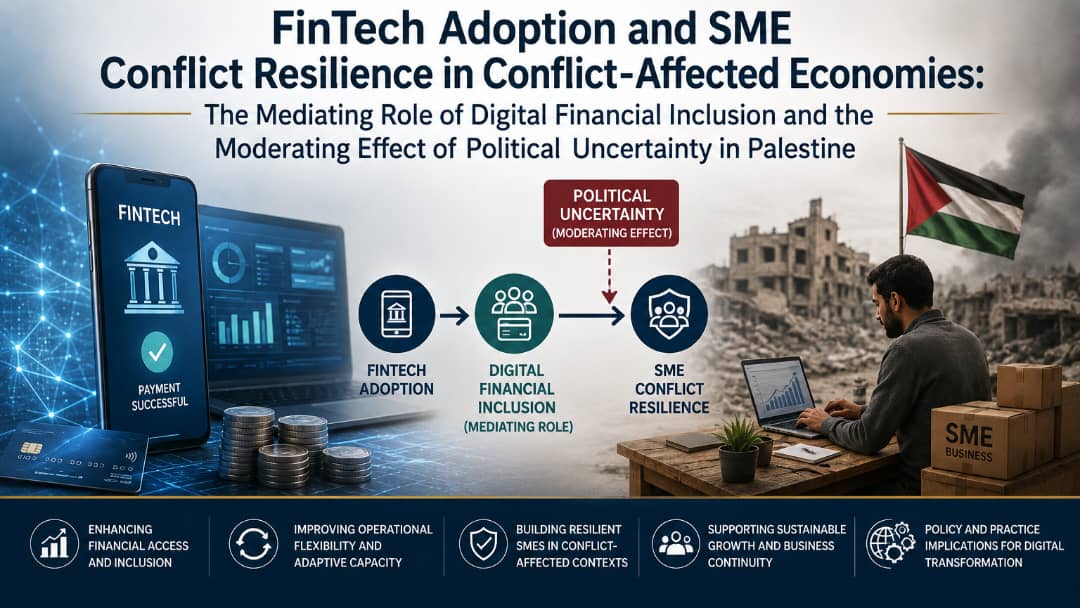
FinTech has emerged as a game-changer, increasing financial accessibility and improving organizational flexibility among small and medium-sized firms (SMEs), Despite increased interest in FinTech adoption little research has looked at how FinTech helps SMEs recover in conflict-ridden and institutionally fragile settings, This research attempts to close this void by examining the link between FinTech uptake and SME resiliency in Palestine, a country plagued by political instability and financial constraints that pose significant hurdles to corporate survival.
Drawing on the Resource-Based View Dynamic Capabilities Theory the Technology–Organization–Environment framework and Organizational Resilience Theory, the study develops and tests an integrated model in which digital financial inclusion serves as a mediating mechanism while political uncertainty acts as a moderating factor, Data were collected from Palestinian SMEs operating across various sectors and analyzed using Partial Least Squares Structural Equation Modeling (PLS-SEM).
The findings reveal that FinTech adoption significantly enhances SME resilience by strengthening access to financial resources increasing operational flexibility and improving adaptive capacity, Digital financial inclusion partially mediates this relationship whereas political uncertainty influences the magnitude of resilience outcomes, The study extends the literature on FinTech and organizational resilience by providing evidence from a conflict-affected economy and highlighting the mechanisms through which digital financial technologies support business sustainability, The findings offer valuable implications for policymakers, regulators, and SME managers seeking to promote resilience through digital financial transformation.

This work is licensed under a Creative Commons Attribution-NonCommercial 4.0 International License.
- 1. Abduallah, M. N. A. A., Jima, V., Abduljalil, H. N. A., Ahmed, O. A. A., & Talib, W. (2025). Digital transformation in banking and its economic impacts: Insights from Yemen and beyond. European Journal of Management, Economics and Business, 2(6), 24-38. https://doi.org/10.59324/ejmeb.2025.2(6).03
- 2. Abualrob, A. A. M., & Kang, J. (2015). The barriers that hinder the adoption of e-commerce by small businesses: Unique hindrance in Palestine. Information Development, 32 (5), 1528–1544. https://doi.org/10.1177/0266666915609774
- 3. Baidoun, S. D., Lussier, R. N., Burbar, M., & Awashra, S. (2018). Prediction model of business success or failure for Palestinian small enterprises in the West Bank. Journal of Entrepreneurship in Emerging Economies, *10*(1), 60–80. https://doi.org/10.1108/JEEE-02-2017-0013[reference:0]
- 4. Barney, J. (1991). Firm resources and sustained competitive advantage. Journal of Management , 17 (1), 99-120. https://doi.org/10.1177/014920639101700108
- 5. Béné, C., Wood, R. G., Newsham, A. J., & Davies, M. (2012). Resilience: New utopia or new tyranny? Reflection about the potentials and limits of the concept of resilience in relation to vulnerability reduction programmes. IDS Working Papers, 2012 (405). https://doi.org/10.1111/j.2040-0209.2012.00405.x
- 6. Boot, A., Hoffmann, P. , Laeven, L. , & Ratnovski, L. (2021). Fintech: What's old, what's new? Journal of Financial Stability, 53(3), 100836. https://doi.org/10.1016/j.jfs.2020.100836
- 7. Brislin, R. W. (1970). Back-translation for cross-cultural research. Journal of Cross-Cultural Psychology, 1 (3), 185-216. https://doi.org/10.1177/135910457000100301
- 8. Brück, T., Naudé, W., & Verwimp, P. (2013). Business under fire: Entrepreneurship and violent conflict in developing countries. Journal of Conflict Resolution, 57 (1). https://doi.org/10.1177/0022002712464846
- 9. Bullough, A., Renko, M., & Myatt, T. (2014). Danger zone entrepreneurs: The importance of resilience and self-efficacy for entrepreneurial intentions. ntrepreneurship Theory and Practice, 38 (3), 473-499. https://doi.org/10.1111/etap.12006
- 10. Creswell, J. W., & Creswell, J. D. (2018). Research design: Qualitative, quantitative, and mixed methods approaches (5th ed.). SAGE.
- 11. Demir, A., Pesqué-Cela, V., Altunbaş, Y., & Murinde, V. (2020). Fintech, financial inclusion and income inequality: A quantile regression approach. The European Journal of Finance, 28 (2), 1–22. https://doi.org/10.1080/1351847X.2020.1772335
- 12. Demirgüç-Kunt, A., Klapper, L., Singer, D., & Ansar, S. (2022). he Global Findex Database 2021: Financial inclusion, digital payments, and resilience in the age of COVID-19. World Bank. https: //doi.org/10.1596/978-1-4648-1897-4
- 13. Demirgüç-Kunt, A., Randall, D., & Klapper, L. (2013). Financial inclusion in fragile and conflict-affected states. All About Finance, World Bank Blogs. https://blogs.worldbank.org/en/allaboutfinance/financial-inclusion-in-fragile-and-conflict-affected-states
- 14. Ding, Y., Wang, Z., & Hu, Y. (2026). FinTech and SME access to credit: Heterogeneous effects across firms. Finance Research Letters, 109997. https://doi.org/10.1016/j.frl.2026.109997
- 15. Duchek, S. (2020). Organizational resilience: A capability-based conceptualization. Business Research, 13 (1), 215-246. https://doi.org/10.1007/s40685-019-0085-7
- 16. Eisenhardt, K. M. (1989). Building theories from case study research. Academy of Management Review, 14 (4), 532-550. https://doi.org/10.2307/258557
- 17. Gbadebo, A. D. (2025). Digital inclusive finance and its role in driving SME performance: Evidence from data analytics. International Journal of Economics and Financial Issues, 15(5), 481–487. https://doi.org/10.32479/ijefi.20986
- 18. Gholeh, I., & Chok, S. (2026). Analyzing the effectiveness of the Palestinian institutional framework in supporting entrepreneurial initiatives in the West Bank: A policy approach within the context of fragile sovereignty. ARADO Business Journal (ABJ), 1 (3). https://doi.org/10.64190/abj.2026.31
- 19. Gomber, P., Koch, J. A., & Siering, M. (2017). Digital finance and FinTech: Current research and future research directions. Journal of Business Economics, 87 (5), 537-580. https://doi.org/10.1007/s11573-017-0852-x
- 20. Herbane, B. (2019). Rethinking organizational resilience and strategic renewal in SMEs. Entrepreneurship and Regional Development, 31 (5-6), 476–495. https://doi.org/10.1080/08985626.2018.1541594
- 21. Hever, S. (2010). The political economy of Israel's occupation: Repression beyond exploitation. Pluto Press. https://doi.org/10.2307/j.ctt183gzjm
- 22. Hillmann, J., & Guenther, E. (2020). Organizational resilience: A valuable construct for management research? International Journal of Management Reviews, 23 (1), 7-44. https://doi.org/10.1111/ijmr.12239
- 23. Hu, Z., Ding, S., Li, S., Chen, L., & Yang, S. (2019). Adoption intention of Fintech services for bank users: An empirical examination with an extended technology acceptance model. Symmetry, 11 (3), 340. https://doi.org/10.3390/sym11030340
- 24. Iborra, M., Safón, V., & Dolz, C. (2019). What explains the resilience of SMEs? Ambidexterity capability and strategic consistency. Long Range Planning , 53 (6), 101947. https://doi.org/10.1016/j.lrp.2019.101947
- 25. Iman, N. (2018). Assessing the dynamics of fintech in Indonesia. Investment Management and Financial Innovations, *15*(4), 296–303. https://doi.org/10.21511/imfi.15(4).2018.24
- 26. Ismail, I. J., & Rashidi, F. U. (2025). Linking dynamic entrepreneurial capabilities and behavioral intentions to adopt FinTech in small and medium enterprises through digital financial innovation. Cogent Business & Management, 12 (1). https://doi.org/10.1080/23311975.2025.2470915
- 27. Kang, J. (2018). Mobile payment in Fintech environment: Trends, security challenges, and services. Human-centric Computing and Information Sciences, 8 (1). https://doi.org/10.1186/s13673-018-0155-4
- 28. Kass-Hanna, J., Lyons, A. C., & Liu, F. (2022). Building financial resilience through financial and digital literacy in South Asia and Sub-Saharan Africa. Emerging Markets Review, 51 (PA). https://doi.org/10.1016/j.ememar.2021.100846
- 29. Korl, Y. Y., Mahoney, J. T., Siemsen, E., & Tan, D. (2016). Penrose's The Theory of the Growth of the Firm: An exemplar of engaged scholarship. Production and Operations Management, 25 (10). https://doi.org/10.1111/poms.12572
- 30. Ky, S., Rugemintwari, C., & Sauviat, A. (2018). Does mobile money affect saving behaviour? Evidence from a developing country. Journal of African Economies, 27 (3), 285–320.
- 31. Lashitew, A. A., van Tulder, R., & Liasse, Y. (2019). Mobile phones for financial inclusion: What explains the diffusion of mobile money innovations? Research Policy, Elsevier, 48 (5), 1201-1215. https://doi.org/10.1016/j.respol.2018.12.010
- 32. Lee, I., & Shin, Y. J. (2018). Fintech: Ecosystem, business models, investment decisions, and challenges. Business Horizons, Elsevier,61 (1), 35-46. https://doi.org/10.1016/j.bushor.2017.09.003
- 33. Lengnick-Hall, C. A., Beck, T. E., & Lengnick-Hall, M. L. (2011). Developing a capacity for organizational resilience through strategic human resource management. Human Resource Management Review, 21 (3), 243-255. https://doi.org/10.1016/j.hrmr.2010.07.001
- 34. Li, W., & Abiad, V. (2009). Institutions, institutional change, and economic performance. SSRN Electronic Journal. https://doi.org/10.2139/ssrn.1416542
- 35. Li, X., Ye, Y., Liu, Z., Tao, Y., & Jiang, J. (2024). FinTech and SME' performance: Evidence from China. Economic Analysis and Policy, 81 (C), 670–682. https://doi.org/10.1016/j.eap.2023.12.026
- 36. Linnenluecke, M. K. (2017). Resilience in business and management research: A review of influential publications and a research agenda. International Journal of Management Reviews, 19 (1), 4-30. https://doi.org/10.1111/ijmr.12076
- 37. McManus, S., Seville, E., Vargo, J., & Brunsdon, D. (2008). Facilitated process for improving organizational resilience.Natural Hazards Review, 9 (2), 81-90. https://doi.org/10.1061/(ASCE)1527-6988(2008)9:2(81)
- 38. Mention, A. L. (2019). The future of Fintech. Research-Technology Management, 62 (4), 59-63. https://doi.org/10.1080/08956308.2019.1613123
- 39. Mujahed, H. M. H., Ahmed, E. M., & Samikon, S. A. (2021). Factors influencing Palestinian small and medium enterprises intention to adopt mobile banking. Journal of Science and Technology Policy Management. Advance online publication. https://doi.org/10.1108/jstpm-05-2020-0090
- 40. Nagy, A. S., Arie, F. V., Tuegeh, O. D. M., Bittner, B., & Tumiwa, J. R. (2025). Fintech adoption for SMEs in different socioeconomic contexts: Evidence from Hungary and Indonesia. Financial Innovation, 11 (1), 1-37. https://doi.org/10.1186/s40854-025-00876-8
- 41. Nambisan, S., Wright, M., & Feldman, M. (2019). The digital transformation of innovation and entrepreneurship: Progress, challenges and key themes. Research Policy, 48 (8), 1–1. . https://doi.org/10.1016/j.respol.2019.03.018
- 42. North, D. C. (1990). Institutions, institutional change and economic performance. Cambridge University Press. https://doi.org/10.1017/CBO9780511808678
- 43. Nugraha, D. P., Setiawan, B., Nathan, R. J., & Fekete-Farkas, M. (2022). Fintech adoption drivers for innovation for SMEs in Indonesia. Journal of Open Innovation: Technology, Market, and Complexity, 8 (4), 208. https://doi.org/10.3390/joitmc8040208
- 44. Nugraha, D. P., Setiawan, B., Nathan, R., & Fekete-Farkas, M. (2022). Fintech adoption drivers for innovation for SMEs in Indonesia. Journal of Open Innovation: Technology, Market, and Complexity, 8 (4), 208. https://doi.org/10.3390/joitmc8040208
- 45. OECD. (2022). SME and entrepreneurship outlook 2022. OECD Publishing. https://doi.org/10.1787/1871e6e2-en
- 46. Okeke, N. I., Bakare, O. A., & Achumie, G. O. (2024). Artificial intelligence in SME financial decision-making: Tools for enhancing efficiency and profitability. Open Access Research Journal of Multidisciplinary Studies, 8 (1), 150–163. https://doi.org/10.53022/oarjms.2024.8.1.0056
- 47. Ozili, P. K. (2018). Impact of digital finance on financial inclusion and stability. Borsa Istanbul Review, 18 (4), 329-340. https://doi.org/10.1016/j.bir.2017.12.003
- 48. Pal, R., Torstensson, H., & Mattila, H. (2014). Antecedents of organizational resilience in economic crises—An empirical study of Swedish textile and clothing SMEs. International Journal of Production Economics, 147, 410-428. https://doi.org/10.1016/j.ijpe.2013.02.031
- 49. Palestine Monetary Authority. (2023). Financial inclusion strategy 2018-2025: Progress report. PMA.
- 50. Palestinian Central Bureau of Statistics. (2023). Establishment census 2022. PCBS.
- 51. Pelling, M. (2011). Adaptation to climate change: From resilience to transformation. Routledge. https://doi.org/10.4324/9780203889046
- 52. Penrose, E. T. (1959). The theory of the growth of the firm. Oxford University Press.
- 53. Philippon, T. (2016). The FinTech opportunity (NBER Working Paper No. 22476). National Bureau of Economic Research. https://www.nber.org/papers/w22476
- 54. Pratama, R. A., & Azzahra, S. (2026). Digital financial inclusion and MSME resilience in post-pandemic Indonesia: An empirical analysis of Fintech adoption and business sustainability. Jurnal Ekonomi, Manajemen, dan Bisnis, 4 (1).1-10 https://doi.org/10.70716/emis.v4i1.460
- 55. Rashid, S., Ejaz, S., Alwadi, B. M., Kumar, A., Ejaz, F., & Hossain, M. B. (2025). Linking financial technology, innovation, and green finance to drive sustainable performance of SMEs of Pakistan. International Journal of Business Innovation and Research, 38 (6). https://doi.org/10.1504/IJBIR.2025.10074485
- 56. Ringle, C. M., Wende, S., & Becker, J. M. (2022). SmartPLS 4. SmartPLS GmbH. https://www.smartpls.com/
- 57. Sahay, R., Eriksson von Allmen, U., Lahreche, A., Khera, P., Ogawa, S., Bazarbash, M., & Beaton, K. (2020). The promise of fintech: Financial inclusion in the post COVID-19 era (Departmental Paper No. 20/09). International Monetary Fund.
- 58. Saunders, M., Lewis, P., & Thornhill, A. (2019). Research methods for business students (8th ed.). Pearson , New York.
- 59. Scott, W. R. (2014). Institutions and organizations: Ideas, interests, and identities (4th ed.). Thousand Oaks, CA: Sage Publishing.
- 60. Shiau, W. L., Yuan, Y., Pu, X., Ray, S., & Chen, C. C. (2020). Understanding fintech continuance: perspectives from self-efficacy and ECT-IS theories. Industrial Management and Data Systems, 120(9), 1659-1689. https://doi.org/10.1108/IMDS-02-2020-0069
- 61. Somers, S. (2009). Measuring resilience potential: An adaptive strategy for organizational crisis planning. Journal of Contingencies and Crisis Management, 17 (1), 12-23. https://doi.org/10.1111/j.1468-5973.2009.00558.x
- 62. Staber, U., & Sydow, J. (2002). Organizational adaptive capacity: A structuration perspective. Journal of Management Inquiry, 11 (4), 408-424. https://doi.org/10.1177/1056492602238848
- 63. Sutcliffe, K.M. and Vogus, T.J. (2003) Organizing for resilience. In: Cameron, K.S., Dutton, J.E. and Quinn, R.E., Eds., Positive Organizational Scholarship: Foundations of a New Discipline, Berrett-Koehler, San Francisco, 94-110.
- 64. Teece, D. J. (2007). Explicating dynamic capabilities: The nature and microfoundations of (sustainable) enterprise performance. Strategic Management Journal, 28 (13), 1319-1350. https://doi.org/10.1002/smj.640
- 65. Teece, D. J., Pisano, G., & Shuen, A. (1997). Dynamic capabilities and strategic management. Strategic Management Journal,18(7),509-533. https://doi.org/10.1002/(SICI)1097-0266(199708)18:7<509::AID-SMJ882>3.0.CO;2-Z
- 66. Thakor, A. V. (2020). Fintech and banking: What do we know? Journal of Financial Intermediation , 41 , 100833. https://doi.org/10.1016/j.jfi.2019.100833
- 67. Tornatzky, L. G., & Fleischer, M. (1990). The processes of technological innovation . (Issues in Organization and Management Series).Lexington Books.
- 68. Vial, G. (2019). Understanding digital transformation: A review and a research agenda. Journal of Strategic Information Systems , 28 (2), 118-144. https://doi.org/10.1016/j.jsis.2019.01.003
- 69. Warner, K. S., & Wäger, M. (2019). Building dynamic capabilities for digital transformation: An ongoing process of strategic renewal. Long Range Planning, 52 (3), 326-349. https://doi.org/10.1016/j.lrp.2018.12.001
- 70. World Bank. (2023). Unlocking SME Finance in Fragile and Conflict Affected Situations. Washington, DC: World Bank.
- 71. World Bank. (2024). Middle East and North Africa Economic Update, October 2024: Conflict and Debt in the Middle East and North Africa. Washington, DC: World Bank