Estimation and Analysis of the Impact of Structural Imbalances on Poverty Rate inIraq for (2004-2023) By Using the (ARDL) model
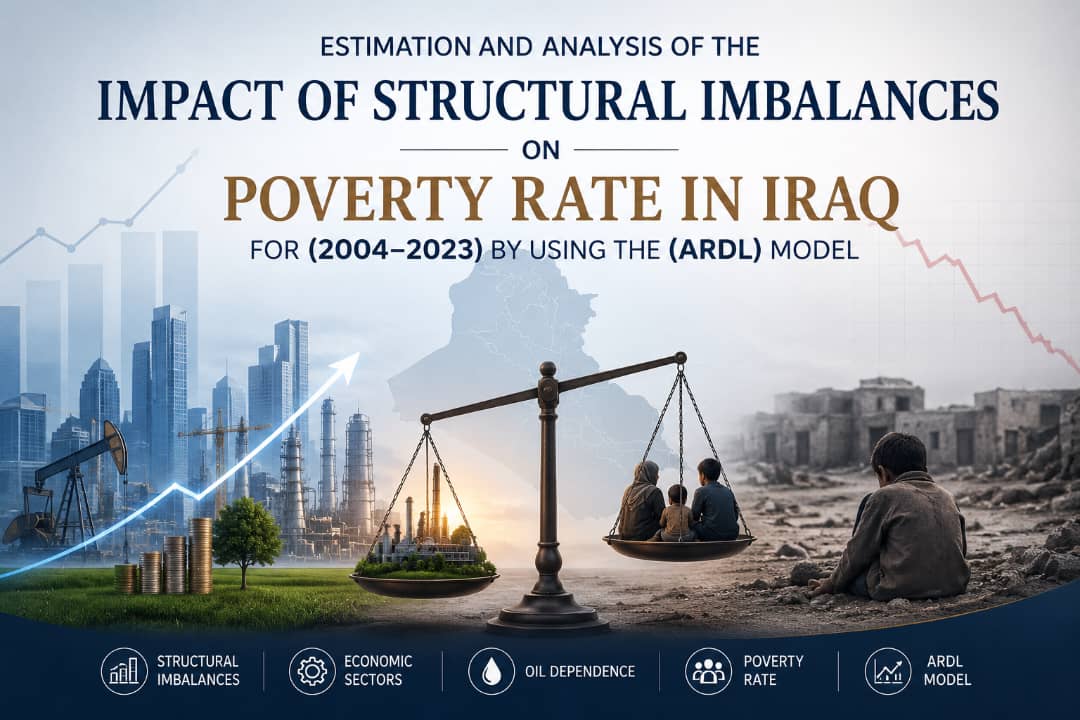
Iraq faces several risks which are stemming from its over-reliance on crude oil to generate unilateral financial surpluses, upon which the macro-economy is based. This study aims to track the impact of the imbalance in the output structure on poverty rates in Iraq, the magnitude of the impact, and their trends, in order to propose practical recommendations that fix this relationship. The research problem lies in the following question: How much does the structural imbalance in the gross domestic product affect poverty rates in Iraq during the period (2004-2023), under the following hypothesis: Structural interdependence (weak structural imbalance) between the output sectors increases the welfare of the economy and reduces Poverty rates. The descriptive and quantitative approach was adopted to validate the research hypothesis. The research reached the validity of its assumption, as the lack of linkage between production sectors (structural imbalance) caused an exacerbation of poverty rates and a deterioration of local production in Iraq. The research recommended the importance of amending agricultural and industrial policies and employing oil resources in achieving a comprehensive economic plan that corrects the local economy.

This work is licensed under a Creative Commons Attribution-NonCommercial 4.0 International License.
- Beatrice Weder di Mauro and Jeromin Zettelmeyer, "The new global imbalances: Why care, why now and what can be done?", CEPR Press, 2026, France & United Kingdom.
- Christopher B. Barrett, Michael R. Carter and Jean-Paul Chavas, The Economics of Asset Accumulation and Poverty Traps, National Bureau of Economic Research (NBER), 2019, United States.
- Daron Acemoglu and Pascual Restrepo, "Automation and Rent Dissipation: Implications for Wages, Inequality, and Productivity", National Bureau of Economic Research (NBER), 2024, United States.
- Giorgio Liotti, "Labour market flexibility, economic crisis and youth unemployment in Italy", Structural Change and Economic Dynamics, Elsevier, 2020, Netherlands.
- International Monetary Fund, Fiscal Policy and Income Inequality, IMF Policy Paper, 2014, United States.
- Justin Yifu Lin and Celestin Monga, "Beating the Odds: Jump-Starting Developing Economies", Princeton University Press, 2022, United States.
- Margaret McMillan, Dani Rodrik and Íñigo Verduzco-Gallo, Globalization, Structural Change, and Productivity Growth, World Development, 2014, United Kingdom.
- Martin Ravallion, On Measuring Global Poverty, Annual Reviews, 2020, United States.
- McMillan, M., Rodrik, D., & Verduzco-Gallo, Í. (2014). Globalization, Structural Change, and Productivity Growth. World Development (Elsevier), 2014, Netherlands.
- Michael Ross, "The Oil Curse: How Petroleum Wealth Shapes the Development of Nations", Princeton University Press, 2015, United States.
- Rey, H., Weder di Mauro, B., & Zettelmeyer, J. (2026). Paris Report 4: The New Global Imbalances. CEPR Press, 2026, France.
- Sabina Alkire and Selim Jahan, The New Global MPI 2018: Aligning with the Sustainable Development Goals, United Nations Development Programme (UNDP), 2018, United States.
- Sabina Alkire, R. Mishra, L. Selden and N. Suppa, The global Multidimensional Poverty Index (MPI) 2025: Country results and methodological note, Oxford Poverty and Human Development Initiative (OPHI), 2025, United Kingdom.
- Thorvaldur Gylfason, Natural Resources, Education, and Economic Development, European Economic Review, 2011, Netherlands.
- Todaro, M. P., & Smith, S. C. (2020). Economic Development (13th Edition). Pearson Education, 2020, United Kingdom.
- Ufuk Akcigit and Sina T. Ates, "Ten Facts on Declining Business Dynamism and Lessons for Monetary Policy", National Bureau of Economic Research, 2021, United States.
- World Bank, World Development Report 2013: Jobs, The World Bank, 2012, United States.