
استخدام الذكاء الاصطناعي القابل للتفسير في استخراج وتفسير الاشارات النقدية من السلوك المالي الرقمي:دليل من الاردن
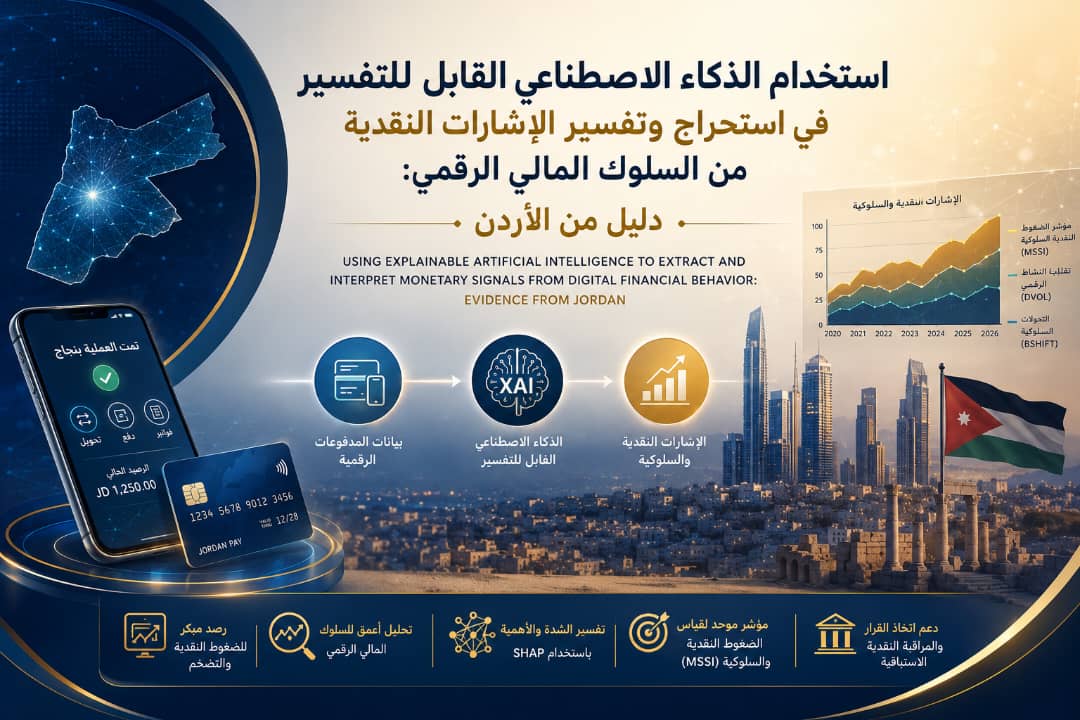
في ظل التسارع المتنامي في استخدام المدفوعات الرقمية، تسعى الدراسة إلى تحليل قدرتها على الكشف عن الإشارات النقدية والسلوكية الكامنة في السلوك المالي الرقمي والمرتبطة بديناميكيات التضخم والضغوط الاقتصادية قصيرة الأجل في الأردن، في ضوء محدودية المؤشرات النقدية التقليدية منخفضة التواتر في رصد التحولات المالية والسلوكية المتسارعة.
المنهج:اعتمدت الدراسة على منهج تحليلي كمي يجمع بين الاقتصاد القياسي وتقنيات الذكاء الاصطناعي القابل للتفسير، بالاستناد إلى بيانات شهرية تغطي الفترة من أغسطس 2020 إلى فبراير 2026. وتم بناء مؤشر النشاط الرقمي للمدفوعات (DPI)، إلى جانب مؤشرات سلوكية رقمية مُجمعة ومؤشر الضغوط النقدية السلوكية (MSSI)، كما تم توظيف نماذج VAR وIRF وFEVD واختبارات سببية جرانجر، فضلًا عن نموذج XGBoost وتقنية SHAP لتحليل العلاقات الديناميكية وغير الخطية.
النتائج:خلصت الدراسة إلى أن بيانات المدفوعات الرقمية تتضمن إشارات نقدية وسلوكية ذات محتوى معلوماتي قابل للتفسير الاقتصادي، وترتبط بديناميكيات التضخم والظروف النقدية قصيرة الأجل. ورغم محدودية العلاقة الخطية المباشرة بين النشاط الرقمي والتضخم، كشفت التحليلات عن أنماط نقدية وسلوكية غير خطية، كما أظهر مؤشر تقلب النشاط الرقمي (DVOL) والتحولات السلوكية (BSHIFT) أهمية تفسيرية أعلى من المستوى الكلي للنشاط الرقمي، في حين أسهم مؤشر الضغوط النقدية السلوكية (MSSI) في تجميع الإشارات الرقمية ضمن مقياس موحد لتطور الضغوط النقدية والسلوكية عبر الزمن.

هذا العمل مرخص بموجب Creative Commons Attribution-NonCommercial 4.0 International License.
- Aliaj, Tesi, Milos Ciganovic, & Massimiliano Tancioni. 2023. Nowcasting inflation with Lasso-regularized vector autoregressions and mixed frequency data. Journal of Forecasting 42(3): 464-80. https://doi.org/10.1002/for.2944
- Aparicio, Diego & Manuel I. Bertolotto. (2020). Forecasting inflation with online prices. International Journal of Forecasting 36(2): 232-47. https://doi.org/10.1016/j.ijforecast.2019.04.018
- Aprigliano, V., Ardizzi, G., & Monteforte, L. (2019). Using Payment System Data to Forecast Economic Activity. International Journal of Central Banking. 15 (4): 55-80
- Badrawani, M. (2025). An Interpretable Machine Learning Approach in Predicting Inflation Using Payments System Data: A Case Study of Indonesia. arXiv:2506.10369 [econ.GN]. arxiv.org. https://doi.org/10.48550/arXiv.2506.10369
- Bank for International Settlements (BIS). (2026). Project Spectrum: Using generative AI to enhance inflation nowcasting. BIS Innovation Hub. https://www.bis.org/publ/othp109.pdf
- Beck, Günter W., Kai Carstensen, Jan-Oliver, M, Richard, S, and Wieland, E. (2023). Nowcasting consumer price inflation using high-frequency scanner data: Evidence from Germany. Deutsche Bundesbank Discussion Paper No. 34/2023.
- Buckmann, M., Joseph, A. (2023). An interpretable machine learning workflow with an application to economic forecasting. International Journal of Central Banking, 19(4), 449–500.
- Cavallo, A. (2013). Online and official price indexes: Measuring Argentina’s inflation. Journal of Monetary Economics, 60(2), 152–165. https://doi.org/10.1016/j.jmoneco.2012.10.002
- Cavallo, A, & Rigobon, R.( 2016). The Billion Prices Project: Using Online Prices for Measurement and Research. Journal of Economic Perspectives. 30(2): 151-78. https://doi.org/10.1257/jep.30.2.151
- Chapman, J., & Desai, A. (2022). Macroeconomic Predictions Using Payments Data and Machine Learning. Bank of Canada Staff Working Paper 2022-10. DOI: https://doi.org/10.34989/swp-2022-10
- Chen, T., & Guestrin, C. (2016). XGBoost: A scalable tree boosting system. In Proceedings of the 22nd ACM SIGKDD International Conference on Knowledge Discovery and Data Mining: 785–794.
- Cimadomo, Jacopo, Domenico Giannone, Michele Lenza, Francesca Monti, and Andrej S. (2022). Nowcasting with large Bayesian vector autoregressions. Journal of Econometrics. 231(2): 500-19. https://doi.org/10.1016/j.jeconom.2021.04.012
- Dedola, L, Henkel, C Höynk, C Osbat & Santoro (2025). What does new micro price evidence tell us about inflation dynamics and monetary policy transmission?. ECB Economic Bulletin, Issue 3.
- Friedman, M. (1961). The lag in effect of monetary policy. Journal of Political Economy, 69(5), 447–466.
- Galbraith, J. W., & Tkacz, G. (2018). Nowcasting with payments system data. International Journal of Forecasting, 34(2), 366–376. https://doi.org/10.1016/j.ijforecast.2016.10.002
- Giannone, D, Lucrezia R, & David S. (2008). Nowcasting: The Real-Time Informational Content of Macroeconomic Data. Journal of Monetary Economics. 55(4): 665–76. https://doi.org/10.1016/j.jmoneco.2008.05.010
- Harchaoui, T., & Janssen, R. (2018). How can big data enhance the timeliness of official statistics?: The case of the U.S. consumer price index. International Journal of Forecasting. 34 (2): 225-234. https://doi.org/10.1016/j.ijforecast.2017.12.002
- Knotek, E & Zaman, S. (2017). Nowcasting U.S. Headline and Core Inflation. Journal of Money, Credit and Banking. 49(5): 931–68. https://doi.org/10.1111/jmcb.12401
- Knotek, E & Zaman, S. (2024). Nowcasting Inflation. Working Paper No. 24-06. Federal Reserve Bank of Cleveland. https://doi.org/10.26509/frbc-wp-202406.
- Lundberg, S. M., & Lee, S.-I. (2017). A unified approach to interpreting model predictions. In Advances in Neural Information Processing Systems. NeurIPS : 4765–4774.
- Macias, P, Damian, S, & Karol, S. (2023). Nowcasting food inflation with a massive amount of online prices. International Journal of Forecasting. 39(2): 809-826. https://doi.org/10.1016/j.ijforecast.2022.02.007
- Mariano, R, & Ozmucur, S. (2021). Predictive Performance of Mixed-Frequency Nowcasting and Forecasting Models (with Application to Philippine Inflation and GDP Growth). Journal of Quantitative Economics. 19: 383–400. https://doi.org/10.1007/s40953-021-00276-6
- Modugno, M. (2013). Now-Casting Inflation Using High Frequency Data. International Journal of Forecasting. 29(4): 664–75. https://doi.org/10.1016/j.ijforecast.2012.12.003
- Sims, C. A. (1992). Interpreting the macroeconomic time series facts: The effects of monetary policy. European Economic Review, 36(5), 975–1000. https://doi.org/10.1016/0014-2921(92)90041-T
- Soybilgen, B, M. Ege Yazgan, & Hüseyin Kaya. (2023). Nowcasting Turkish Food Inflation Using Daily Online Prices. Journal of Business Cycle Research 19: 171-90. https://doi.org/10.1007/s41549-023-00084-2
- Tissot, B., & De Beer, B. (2020). Implications of Covid-19 for official statistics: A central banking perspective. (IFC Working Papers No. 20). Bank for International Settlements. https://www.bis.org/ifc/publ/ifcwp20.htm
- Zheng, Tingguo, Xinyue Fan, Wei Jin, and Kuangnan Fang. (2023). Words or Numbers? Macroeconomic Nowcasting with Textual and Macroeconomic Data. International Journal of Forecasting. https://doi.org/10.1016/j.ijforecast.2023.05.006
المؤلفات المشابهة
- م.م. وابلة مهدي صالح, أثر السياسات النقدية في إستقرار القطاع المصرفي العراقي دراسة قياسية تحليليلة للمدة (2015–2025) , المجلة الدولية للدراسات الاقتصادية: مجلد 9 عدد 38 (2026): مجلد 9 عدد 38 (2026): Issue 38
- Hawraa Radhi Sabih Al-Musaed, تطوير النظام المحاسبي العراقي بما يتلائم مع متطلبات الاقتصاد الرقمي:دراسة تحليلية للمعوقات والفرص في المؤسسات الخدمية , المجلة الدولية للدراسات الاقتصادية: مجلد 9 عدد 38 (2026): مجلد 9 عدد 38 (2026): Issue 38
- Hussam Al-Din Jumaa Asfeeh, اثر التحول الرقمي واستخدام تكنولوجيا السحابة المحاسبية في تعزيز كفاءة أنظمة الرقابة الداخلية:دراسة مقارنة بين المصارف الحكومية والأهلية في العراق , المجلة الدولية للدراسات الاقتصادية: مجلد 9 عدد 38 (2026): مجلد 9 عدد 38 (2026): Issue 38
- Dr.Musab Rushdi Khalil, FinTech Adoption and SME Conflict Resilience in -Affected Economies:The Mediating Role of Digital Financial Inclusion and the ModeratingEffect of Political Uncertainty in Palestine , المجلة الدولية للدراسات الاقتصادية: مجلد 9 عدد 38 (2026): مجلد 9 عدد 38 (2026): Issue 38
- Dr. Ali Fahim Jafar, Dr. Ibrahim Khalil Sultan, Financial-monetary integration and sustainable development in Iraq:analysis of the asymmetric impact of green financing thresholds using thetvar-Copula model , المجلة الدولية للدراسات الاقتصادية: مجلد 9 عدد 38 (2026): مجلد 9 عدد 38 (2026): Issue 38
- shatha salem dily, Ibrahim khalil sultan, The Impact of Oil Price Fluctuations on Economic Growth in Iraq: A Dynamic Econometric Analysis Using the Vector Autoregression (VAR) Model , المجلة الدولية للدراسات الاقتصادية: مجلد 9 عدد 37 (2026): المجلة الدولية للدراسات الاقتصادية
- خالد بن سلام بن سالم العامري, العوامل المحددة لنجاح الشركات الناشئة في سلطنة عُمان: مراجعة أدبية تحليلية , المجلة الدولية للدراسات الاقتصادية: مجلد 9 عدد 37 (2026): المجلة الدولية للدراسات الاقتصادية
- Mohammed Hamid Hammad Habib, دور المرونةالمالية كمتغير وسيط في العلاقة ين التنويع الاستثماري والعائد المعدل حسب المخاطر: دراسة تطبيقية لعينة من الشركات الصناعية المدرجة في سوق العراق للاوراق المالية , المجلة الدولية للدراسات الاقتصادية: مجلد 9 عدد 38 (2026): مجلد 9 عدد 38 (2026): Issue 38
يمكنك أيضاً إبدأ بحثاً متقدماً عن المشابهات لهذا المؤلَّف.