Fragmentation géopolitique mondiale et reconfiguration des partenariats commerciaux africains : une analyse fondée sur un modèle gravitationnel (2010-2021)
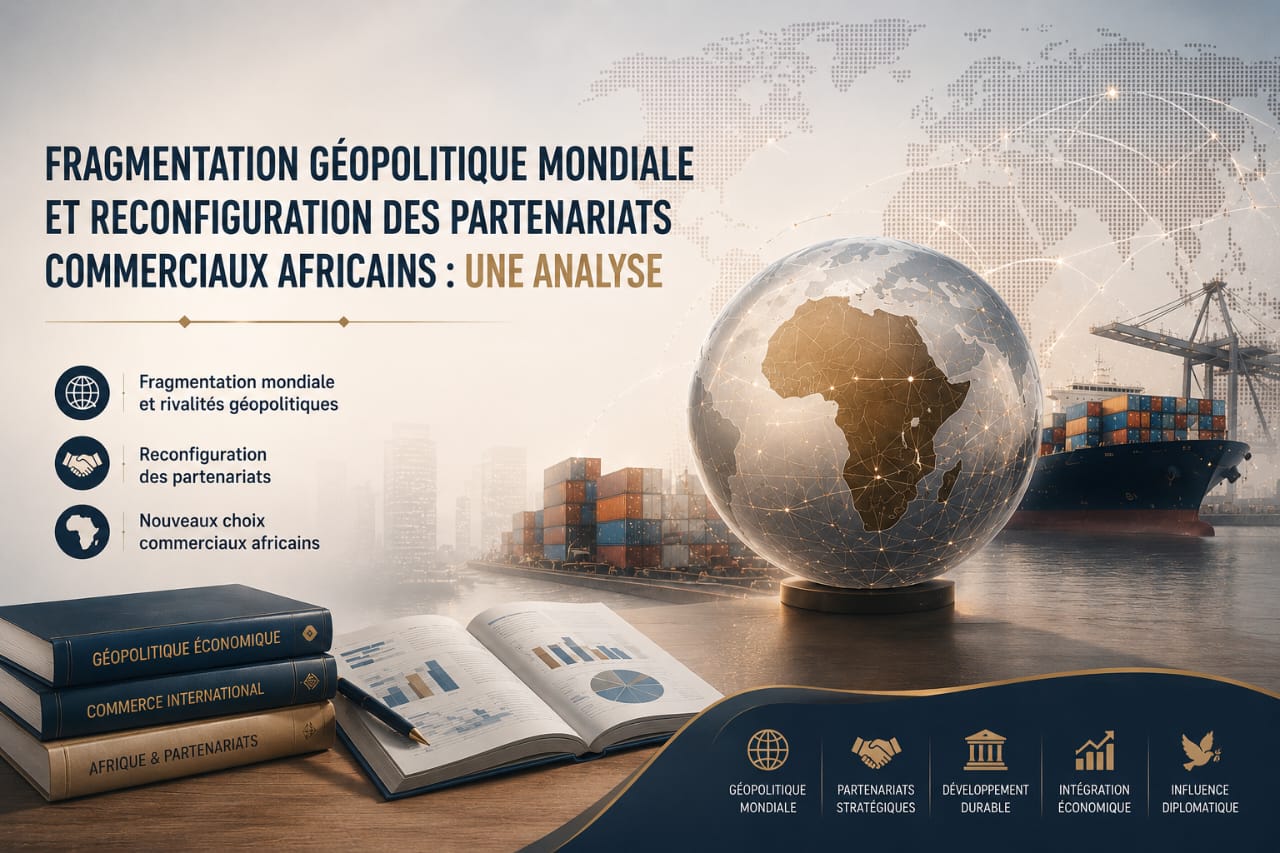
Cet article analyse l'effet de la fragmentation mondiale sur le commerce en Afrique, en se basant sur un modèle gravitationnel appliqué aux échanges commerciaux de 56 pays africains entre 2010 et 2021. L'analyse explore l'évolution des relations commerciales de l'Afrique avec ses principaux partenaires dans le contexte de tensions géopolitiques croissantes et de l'émergence de nouveaux blocs économiques. Les résultats montrent une transformation significative dans la structure des partenaires commerciaux de l'Afrique, avec une hausse notable de l'influence des BRICS, en particulier la Chine, dont le rôle dans le commerce africain a considérablement augmenté au cours de la période étudiée. En parallèle, les partenaires traditionnels de l'Afrique, tels que l'Union européenne, voient leur importance relative diminuer. L'étude révèle que cette reconfiguration des échanges pourrait avoir des implications majeures pour la politique commerciale et le développement économique en Afrique, notamment en matière de dépendance économique et de diversification des marchés d’exportation.

هذا العمل مرخص بموجب Creative Commons Attribution-NonCommercial 4.0 International License.
- Airaudo, F., de Soyres, F., Richards, K., & Santacreu, A. M. (2025). Measuring geopolitical fragmentation: Implications for trade, financial flows, and economic policy. Federal Reserve Bank of St. Louis Review.
- Ajakaiye, O., & Ncube, M. (2010). Infrastructure and economic development in Africa: A review. Journal of African Economies.
- Ajayi, S. I., & Ndikumana, L. (Eds.). (2015). Capital flight from Africa: Causes, effects, and policy issues. Oxford University Press.
- Anderson, J. E. (2011). The gravity model. Annual Review of Economics, 3, 133–160.
- Anderson, J. E., & Van Wincoop, E. (2003). Gravity with gravitas: A solution to the border puzzle. American Economic Review, 93(1), 170–192.
- Baliamoune-Lutz, M. (2011). Growth by destination (where you export matters): Trade with China and growth in African countries. African Development Review, 23(2), 202–218.
- Boulat, R. (2024). Conflicts and the new scramble for African resources: A shift-share approach (Working Paper).
- Busse, M., Erdogan, C., & Mühlen, H. (2016). China’s impact on Africa: The role of trade, FDI and aid. Journal of African Economies, 25(4), 479–517.
- Catalán, M., Fendoglu, S., & Tsuruga, T. (2024). A gravity model of geopolitics and financial fragmentation (IMF Working Paper No. 2024/196).
- Choramo, T. T., Abafita, J., Gandica, Y., & Rocha, L. E. C. (2024). Economic integration of Africa in the 21st century: Complex network and panel regression analysis (Working Paper).
- Hakobyan, S., Meleshchuk, S., & Zymek, R. (2023). Divided we fall: Differential exposure to geopolitical fragmentation in trade (IMF Working Paper No. 2023/270).
- Head, K., & Mayer, T. (2014). Gravity equations: Workhorse, toolkit, and cookbook. In G. Gopinath, E. Helpman, & K. Rogoff (Eds.), Handbook of International Economics (Vol. 4, pp. 131–195). Elsevier.
- International Monetary Fund. (2024). How vulnerable is Sub-Saharan Africa to geoeconomic fragmentation? (IMF Working Paper No. 2024/083).
- Kabundi, A., & Loots, E. (2007). The relationship between commodity prices and exports in South Africa: Evidence from correlation and Granger causality tests. Journal of Studies in Economics and Econometrics, 31(1), 41–56.
- Kassa, W., Coulibaly, S., & Zeufack, A. G. (2018). Monetary policy and regional integration in Sub-Saharan Africa: A structural vector autoregression analysis. Journal of African Economies.
- Lesser, C., & Moisé-Leeman, E. (2009). Informal cross-border trade and trade facilitation reform in Sub-Saharan Africa (OECD Trade Policy Papers No. 86). Organisation for Economic Co-operation and Development.
- Linnemann, H. (1966). An econometric study of international trade flows. North-Holland Publishing.
- Ndao, M. S. (2024). Analyse de l’évolution des échanges commerciaux intra-zone en Afrique de l’Ouest. Revue Française d’Économie et de Gestion, 5(2), 501–518.
- Ngepah, N. (2017). A review of theories and empirics of regional integration in Africa. Development Southern Africa.
- Nkurunziza, J. D., Ndikumana, L., & Nyamoya, P. (2017). The impact of Chinese trade and investment on income inequality in Sub-Saharan Africa. African Development Review, 29(2).
- North, D. C. (1990). Institutions, institutional change and economic performance. Cambridge University Press.
- Olayungbo, D. O., & Iqbal, B. A. (2021). An empirical analysis of African trade blocs effects on the global economy: New evidence from the gravity model. Future Business Journal, 7(45).
- Olayungbo, D. O., & Quadri, A. (2019). Remittances, financial development and economic growth in Sub-Saharan African countries: Evidence from a PMG-ARDL panel approach. Financial Innovation.
- Prebisch, R. (1950). The economic development of Latin America and its principal problems. United Nations.
- Saygili, M., Peters, R., & Knebel, C. (2018). African Continental Free Trade Area: Challenges and opportunities of tariff reductions. Journal of Economic Integration, 33(4), 424–448.
- Signe, L., & van der Ven, C. (2020). Keys to success for the AfCFTA negotiations. Brookings Institution.
- Söderbom, M., Teal, F., & Wambugu, A. (2020). Productivity, capital and labor in African manufacturing. African Journal of Economic and Management Studies.
- Tinbergen, J. (1962). Shaping the world economy: Suggestions for an international economic policy. The Twentieth Century Fund.
- Venables, A. J. (2016). Using natural resources for development: Why has it proven so difficult? Journal of Economic Perspectives, 30(1), 161–184.
- Yotov, Y. V., Piermartini, R., Monteiro, J. A., & Larch, M. (2016). An advanced guide to trade policy analysis: The structural gravity model. World Trade Organization.
- Rapports institutionnels et documents de travail
- African Union & African Development Bank. (2019). Africa’s Development Dynamics 2019: Achieving Productive Transformation. African Union Commission.
- Banque mondiale. (2020). The African Continental Free Trade Area: Economic and Distributional Effects. World Bank Report.
- Songwe, V. (2019). The African Continental Free Trade Area: A Historical Institution for Africa. Brookings Institution Policy Brief.
- UNECA (Commission Économique pour l’Afrique). (2020). Facilitating Cross-border Trade through a Coordinated African Response to COVID-19.
- World Bank Group. (2020). The African Continental Free Trade Area: Economic and Distributional Effects. World Bank Report.